We would love to hear from you, to discuss how our business can help yours. We would be delighted to visit your premises to provide a free no obligation quote, whether you are yet to employ a cleaning company, or if you are unhappy with your current one. You can either call us on 0333 050 1139 or fill in this form - We will call you back as soon as possible.
Colour coding in cleaning - great information on why 4 colours are so important!
Table of Contents
Colour coding in cleaning - what's it all about and why does it matter?
Commercial cleaning is a skill when done professionally, with clear and strict processes in place to minimise the threat of cross‑contamination. These processes aren’t just “nice to have” — they’re essential for maintaining safe working practices and protecting the people who use a building every day.
One of the simplest but most effective ways to achieve this is by following a colour‑coding system. But what exactly is colour coding in cleaning, and how does it work?
Colour‑coded cleaning was first introduced in the 1990s for hospitals and clinical environments, where hygiene standards must be exceptionally high. The system proved so effective that it quickly spread across the wider cleaning and catering industries. Today, it’s widely recognised as best practice for any business that wants to maintain consistently high hygiene standards.
There are typically four key colours used in the commercial cleaning sector. Each colour is assigned to a specific area of a building, and the British Institute of Cleaning Science (BICSc) provides clear guidance on how these colours should be used. At Green Fox Cleaning, we fully adhere to these standards across all sites we clean.
In the simplest terms:
you don’t use the same mop or cloth in a toilet that you then use in a kitchen or office.
Colour coding makes this mistake far less likely and helps maintain a safe, hygienic environment.
Colour coding in cleaning
What are the four colours for colour coding in cleaning?
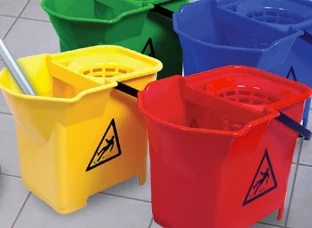
There are four main colours used in commercial cleaning. Each one has a specific purpose.
RED – Washrooms (high‑risk areas)
Red cloths, mops and buckets should only ever be used in washrooms, including toilets and urinals. These areas carry the highest risk of contamination.
BLUE – General low‑risk areas
Blue equipment is used in offices, hallways, reception areas and other general spaces where the risk of contamination is low.
GREEN – Food preparation and consumption areas
Green cloths, mops and buckets are used in kitchens, canteens, restaurants and anywhere food is prepared or served.
YELLOW – Clinical and healthcare settings
Yellow equipment is used in treatment rooms, hospital wards, GP surgeries and similar environments where hygiene is critical.
This simple system helps ensure that cleaning tools never move from a high‑risk area to a low‑risk one.
Colour coding in cleaning
What items can be colour coded in cleaning?
A wide range of cleaning tools can be colour coded. This makes it easy for staff to grab the correct equipment instantly and for managers to audit cleaning practices at a glance.
Common colour‑coded items include:
Mop heads and handles
Mop buckets (plastic or metal)
Rubber brooms
Dustpan and brush sets
Microfibre cloths
Sponge scourers
Industrial cleaning gloves
Grout brushes
Trigger spray bottles
Using colour‑coded versions of these tools helps keep cleaning processes consistent and reduces the risk of cross‑contamination.
Common mistakes businesses make with colour coding
Even with a colour‑coding system in place, mistakes can still happen. Some of the most common include:
Not replacing worn or faded equipment
If colours fade, staff can’t easily identify the correct tools.
Mixing equipment between sites
Tools should stay on the site they’re assigned to.
Not training new staff properly
Colour coding only works when everyone understands it.
Using multi‑purpose sprays across all areas
Chemicals should be matched to the risk level of each zone.
Storing equipment incorrectly
Colour‑coded tools should be stored separately to avoid mix‑ups.
Avoiding these mistakes helps maintain the integrity of the colour‑coding system.
How Green Fox Cleaning trains staff on colour coding
At Green Fox Cleaning, colour coding isn’t just a guideline — it’s a core part of our training and daily operations.
Our training includes:
Clear explanations of each colour and its purpose
Real‑world examples of cross‑contamination risks
Practical demonstrations on site
Regular refresher training
Supervisor audits to ensure compliance
Immediate corrective action if standards slip
This ensures every cleaner understands not just what to do, but why it matters.
What are the main benefits of colour coding in cleaning?
Colour coding offers several important advantages:
Reduces the potential risk of cross‑contamination
Provides a quick visual indicator for managers when auditing
Removes language barriers — colours are universally understood
Simplifies training for a diverse workforce
Makes it easier to separate and organise tools
Increases customer confidence in cleanliness
Of course, none of this matters if your commercial cleaning company doesn’t fully train their staff in colour coding and its importance, as well as all other aspects of cleaning.
In summary
Sticking to colour‑coded equipment ensures there is no cross‑contamination during the cleaning process. It prevents harmful bacteria from being transferred around a premises and helps reduce the risk of infection.
To find out about our professional, fully colour‑coded and reliable commercial cleaning services — and how we can help improve the appearance of your premises — click here to contact your LOCAL office.
FAQs
Why is colour coding important in commercial cleaning?
It prevents cross‑contamination by ensuring cleaning tools are only used in the correct areas.
Who sets the colour‑coding standards?
In the UK, the British Institute of Cleaning Science (BICSc) provides the most widely used guidelines.
Do all cleaning companies follow colour coding?
Not always — which is why choosing a company that trains staff properly is essential.